Private Networking and VPNs for Cloud Infrastructure
The goal is that nothing sensitive has a public address at all. Private networking and a VPN are how you get there.
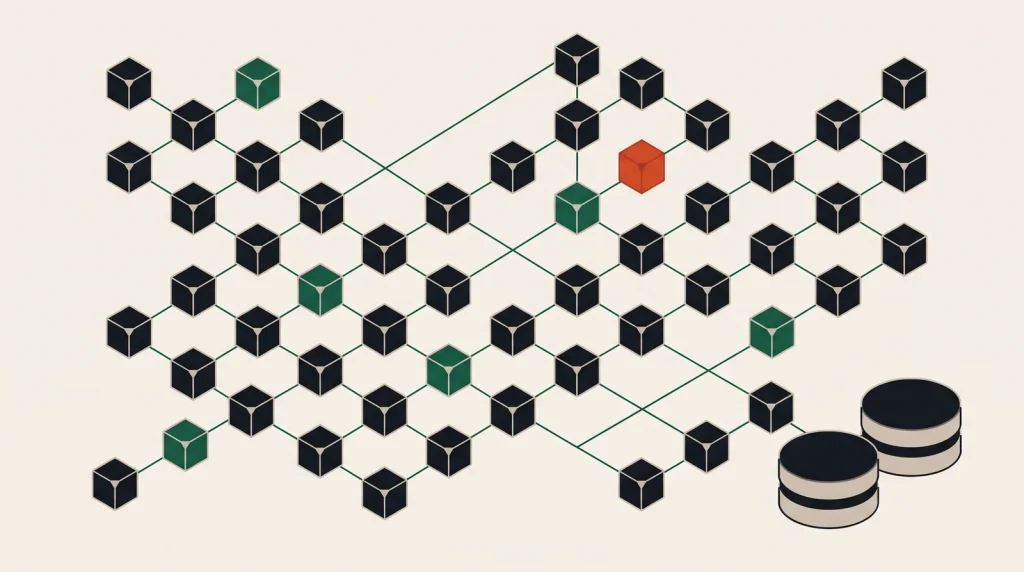
The strongest form of network security is not a firewall rule. It is not having a public address in the first place. Private networking makes that practical.
Private networks between your own servers
Every provider offers a private network within a region. Instances get a private address and communicate over it without touching the internet.
- Traffic within one zone is usually free; cross-zone often is not.
- It is faster, since it stays within the provider network.
- It is not automatically encrypted — it is private, not confidential. Use TLS for anything sensitive.
- Firewall rules still apply and still matter. Treat the private network as semi-trusted, not trusted.
The last point is worth internalising. Lateral movement after an initial compromise is exactly what internal firewall rules limit.
Reaching private resources
| Method | How it works | Suits |
|---|---|---|
| Bastion host | One hardened public entry point; hop through it | Traditional, works everywhere |
| Provider session manager | Connect through the control plane, no open port | Best where available |
| Site-to-site VPN | Encrypted tunnel from office or data centre | Permanent connectivity |
| Client VPN | Individual users connect to the network | Remote teams |
| Overlay mesh VPN | Peer-to-peer encrypted network across machines | Mixed and multi-cloud estates |
Session managers — connecting through the provider’s control plane with IAM-based authorisation and full audit logging — are the strongest option where available, because no SSH port is exposed at all.
WireGuard and mesh VPNs
WireGuard is fast, simple and built into modern Linux kernels. Mesh products built on it create an encrypted private network across machines regardless of which provider they sit in.
- Works across providers, which plain provider networking does not.
- Each machine gets a stable private address that survives address changes.
- Authentication can tie into your existing identity provider.
- Access can be scoped per user and per machine, which a flat VPN cannot do.
For a small team spanning several providers, this is often simpler and better than building peering and VPN gateways.
Private endpoints for provider services
By default, calls from your instances to object storage, managed databases and provider APIs go over the internet or through a NAT gateway. Private endpoints keep that traffic inside the provider network.
- Lower latency, since the path is shorter.
- Lower cost, because NAT processing charges are avoided.
- Better security, since the traffic never traverses the internet.
- Often required for compliance, and easy evidence to produce.
For estates with significant traffic to object storage, this frequently pays for itself in avoided NAT charges alone.
A sound default layout
- Load balancer in a public subnet — the only thing with a public address.
- Application servers in a private subnet, reachable only from the load balancer.
- Database in a private subnet, reachable only from application servers.
- Outbound access through NAT, or private endpoints where available.
- Administrative access through a session manager or a bastion, never direct SSH from the internet.
- Firewall rules between each tier, not only at the perimeter.
This is the standard three-tier layout and it is standard because it works. Anything holding data has no route from the internet.
Common questions
Is private network traffic encrypted?
Not inherently. It is isolated from other tenants and it is not confidential in a cryptographic sense. Use TLS between services for sensitive data.
Do I need a VPN if I use a bastion?
Not necessarily — a well-configured bastion with key-only SSH covers administrative access. A VPN is more convenient when several people need access to several private services.
Can I connect two providers privately?
With a VPN tunnel or a mesh network, yes. There is no native private peering between unrelated providers, and traffic between them is billed as egress on both sides.
What about IPv6 on private networks?
Support varies. Where it exists, remember that firewall rules written for IPv4 do not cover IPv6, which is a common way to leave a service unintentionally reachable.
Where to go next
See cloud networking basics and security groups and firewalls.
Read next
DNS for Cloud Services: The Layer Everything Depends On
DNS sits upstream of all your redundancy. A mistake here takes everything down regardless of how well the rest is…
CDNs and Caching: The Cheapest Performance You Can Buy
A CDN makes a site faster, cheaper and more resilient at the same time. Very few infrastructure changes do all three.
Object, Block and File Storage: Which One You Need
Three kinds of cloud storage with very different prices and properties. Using the wrong one is expensive and awkward.