Cloud Networking Basics: VPCs, Subnets and Gateways
Cloud networking is a small number of concepts with different names on every platform. Learn the concepts once.
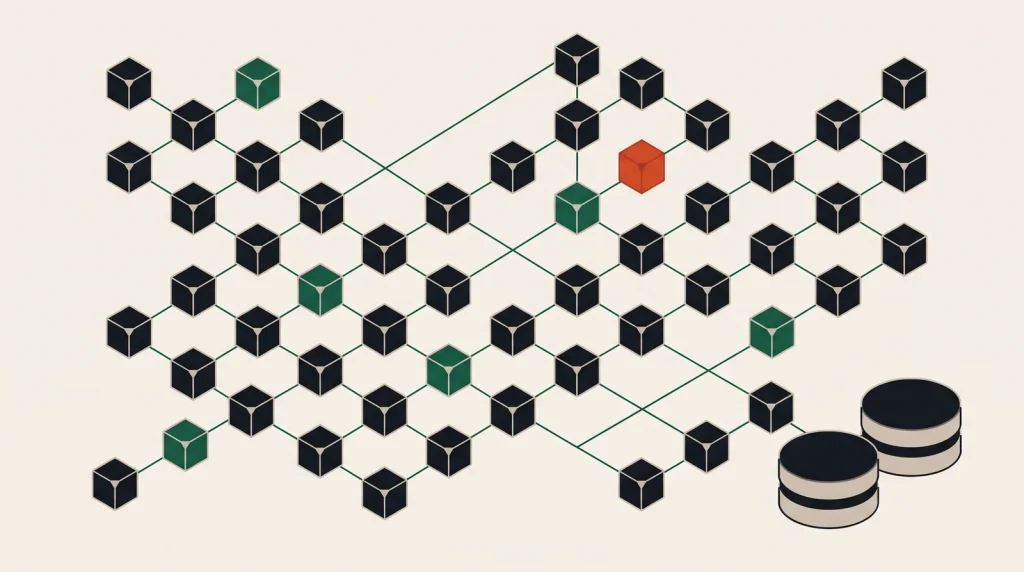
Every cloud platform gives you a private network, divides it into subnets, and provides gateways to the outside world. The names differ. The model does not.
The vocabulary
| Concept | AWS | Azure | Google Cloud |
|---|---|---|---|
| Private network | VPC | Virtual Network | VPC network |
| Subdivision | Subnet | Subnet | Subnet |
| Outbound for private hosts | NAT Gateway | NAT Gateway | Cloud NAT |
| Internet entry point | Internet Gateway | Implicit | Default route |
| Instance firewall | Security Group | Network Security Group | Firewall rules |
| Private service access | VPC Endpoint | Private Endpoint | Private Service Connect |
One structural difference worth knowing: AWS and Azure subnets are zonal or regional per subnet, while Google Cloud subnets span an entire region. It affects how you lay out a multi-zone design.
Public and private subnets
The distinction is entirely about routing, not about a setting called “public”.
- Public subnet — has a route to an internet gateway. Instances with a public address are reachable from the internet.
- Private subnet — no direct internet route. Instances reach out through a NAT gateway and cannot be reached inbound.
The standard layout: load balancers and bastion hosts in public subnets; application servers and databases in private ones. Nothing holding data should be publicly routable.
Plan the address space before you build
- Choose a private range — 10.0.0.0/8 gives the most room.
- Allocate a distinct block per environment, so production and staging never overlap.
- Leave gaps between allocations for growth.
- Avoid overlapping with anything you might later connect to — an office network, a partner, another cloud.
- Size subnets generously. Growing them later ranges from awkward to impossible.
- Write the plan down. Address allocation lives longer than most infrastructure decisions.
Overlapping address ranges is the mistake that surfaces years later when you try to connect two networks and cannot. It is trivial to avoid at the start and expensive to fix afterwards.
NAT gateways cost real money
A NAT gateway bills hourly plus per gigabyte processed. In a three-zone design with one per zone, running continuously, that becomes a meaningful line item — sometimes more than the instances behind it.
- Use private endpoints for provider services, so that traffic bypasses NAT entirely.
- Consider one NAT gateway shared across zones for non-critical workloads, accepting the availability trade.
- For low-traffic private instances, a small NAT instance can be much cheaper than a managed gateway.
- Check what is actually generating outbound traffic; it is often package downloads that could be cached.
Connecting networks
| Method | Use for | Note |
|---|---|---|
| VPC peering | Two networks, same or different accounts | Not transitive |
| Transit gateway / hub | Many networks | Simplifies a mesh into a hub and spoke |
| VPN | Office or on-premises connectivity | Over the internet, encrypted |
| Direct connection | High bandwidth to on-premises | Dedicated circuit, higher cost |
| Private service connect | Provider services without internet | Reduces cost and exposure |
Peering not being transitive catches people out: if A peers with B and B peers with C, A cannot reach C. That is what transit gateways exist to solve.
What VPS providers offer
Hetzner, DigitalOcean, Linode, UpCloud and others provide private networking that covers the common case well — a private network per region, instances communicating over private addresses, and a cloud firewall.
What is usually absent is the deeper machinery: transit gateways, sophisticated routing, private service endpoints. For a single-region application that is rarely a limitation.
Common questions
Do I need multiple subnets?
Yes, at minimum public and private, and ideally one of each per availability zone. Many managed services require subnets in at least two zones.
Can I change a VPC address range later?
Additional ranges can be added on most platforms; the primary range generally cannot be changed. Plan it once, properly.
Is private networking traffic free?
Within one availability zone, usually yes. Across zones it is often billed in both directions, which surprises people in multi-zone designs.
Do I need a bastion host?
It is the traditional approach. Provider session managers — connecting through the control plane rather than SSH — are increasingly better, since there is no exposed port at all.
Where to go next
See security groups and firewalls and private networking and VPNs.
Read next
Object, Block and File Storage: Which One You Need
Three kinds of cloud storage with very different prices and properties. Using the wrong one is expensive and awkward.
DNS for Cloud Services: The Layer Everything Depends On
DNS sits upstream of all your redundancy. A mistake here takes everything down regardless of how well the rest is…
Private Networking and VPNs for Cloud Infrastructure
The goal is that nothing sensitive has a public address at all. Private networking and a VPN are how you get there.