Multi-Cloud: When It Makes Sense and When It Is a Tax
Using two providers is sometimes obviously right and often just twice the operational surface for no benefit.
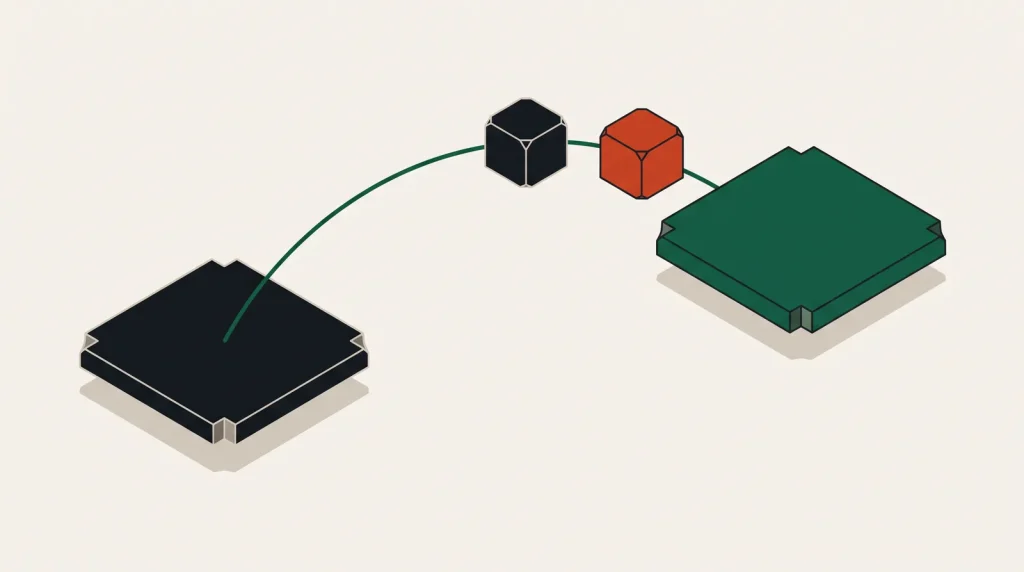
Multi-cloud covers several different things: running the same workload on two providers, running different workloads on different providers, or simply keeping the option to move. They have very different costs.
The three meanings
| Pattern | What it means | Cost |
|---|---|---|
| Portable | Could move if needed, running on one | Low — mostly design discipline |
| Distributed | Different workloads on different providers | Moderate — two sets of tooling |
| Redundant | The same workload live on both | High — everything twice |
Most teams that say multi-cloud mean the first or second. The third is genuinely expensive and rarely justified outside specific regulatory or contractual requirements.
Good reasons
- Cost arbitrage. Bulk compute or bandwidth on a cheaper provider while using specialised services elsewhere. This is the most common sound reason.
- A specific capability available on one provider and not another.
- Data residency requiring a provider with presence in a particular country.
- Contractual or regulatory requirements naming provider diversity.
- Acquisition, where you inherit an estate and consolidation is not worth it.
- Negotiating position, which is real at large contract sizes and irrelevant at small ones.
Weaker reasons
- “Avoiding lock-in” in the abstract, without a scenario in which you would actually move.
- “Redundancy against provider outage” — multi-region on one provider addresses most of this at a fraction of the cost.
- “Best of breed for every service”, which usually means integration work exceeding the benefit.
- “It is what large companies do”, where the constraints are entirely different.
Provider-wide outages are rare; regional outages are more common and handled within one provider. The redundancy argument is weaker than it sounds.
The costs, which are ongoing
- Egress between providers. Data leaving one and entering another is billed, often the largest recurring cost.
- Two sets of expertise. Different IAM models, networking, tooling and failure modes.
- Two sets of tooling for monitoring, deployment, cost management and security.
- Latency between providers, which affects anything chatty across the boundary.
- Lowest common denominator architecture, if you insist on portability across both.
- Doubled security surface — two sets of credentials, policies and audit logs.
The expertise cost is the one that persists. Every incident requires someone who knows the relevant platform well.
Lighter alternatives
Most of the benefit, much less of the cost:
- Containers everywhere. Portable by construction, without running anywhere else today.
- Standard technologies — PostgreSQL rather than a proprietary database, S3-compatible object storage APIs, Kubernetes if you already have it.
- Infrastructure as code, so rebuilding elsewhere is a known quantity.
- Backups with a second provider, which gives real protection against account-level problems at very low cost.
- Multi-region within one provider for availability.
- A documented exit plan, tested at least on paper.
Backups with a second provider deserves particular attention: it costs very little and covers the scenario people actually fear.
If you do it, do it cleanly
- Split by workload, not by component. Keep tightly coupled things together on one provider.
- Minimise cross-provider traffic; it is the cost and the latency.
- Use one identity provider across both, so access management is not duplicated.
- Centralise monitoring and logging into one place.
- Write down which provider owns which workload and why.
- Review annually; inherited multi-cloud often outlives its reason.
Common questions
Does multi-cloud improve availability?
Only in the redundant pattern, which is expensive and complex. Multi-region on one provider achieves more availability per unit of effort for almost everyone.
Is Kubernetes the answer to portability?
It helps with workload portability and does not remove dependency on networking, storage, identity and managed services, which differ substantially between providers.
What is a realistic hybrid?
Bulk compute and bandwidth on a cost-effective VPS provider, specific managed services on a hyperscaler, with minimal traffic between them. Many teams run exactly this.
How do I keep an exit option cheaply?
Containers, standard data formats, infrastructure as code, and regular backups you could restore elsewhere. That is most of the benefit for very little cost.
Where to go next
See hyperscaler versus VPS provider and planning a cloud migration.
Read next
Moving Off a Cloud Provider Without Drama
Leaving is harder than arriving, mostly because of things that accumulated quietly: managed services, egress and…
Planning a Cloud Migration That Does Not Overrun
Migrations overrun because the inventory was incomplete, not because the technology was hard. Start with the list.
Database Migration Strategies
The database is the hardest part of any migration, because it is the only part where a mistake loses something you…