Load Balancing Basics for Cloud Servers
A load balancer distributes traffic. More usefully, it removes broken servers from rotation before your users find them.
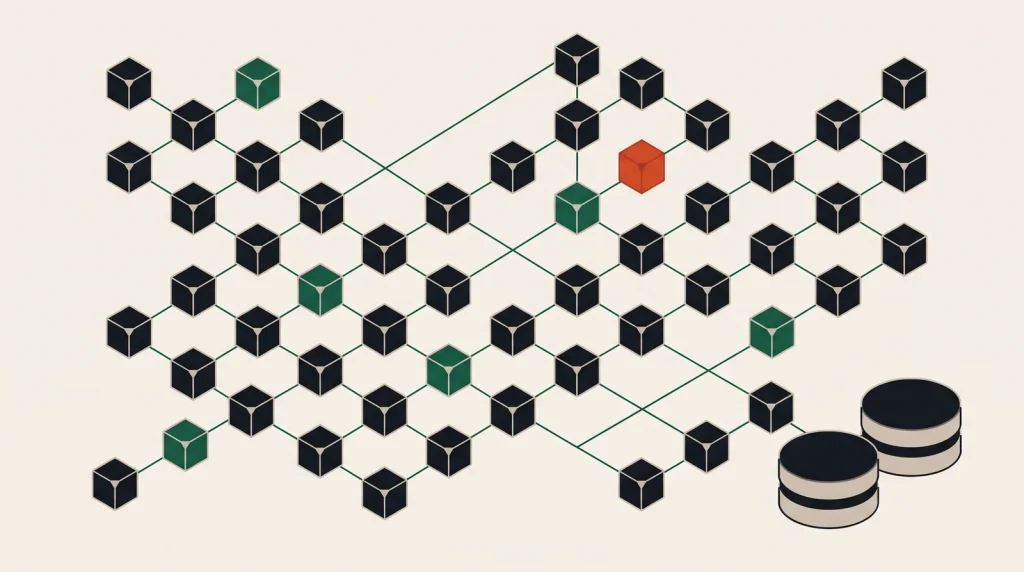
People add a load balancer to spread traffic. The larger benefit is that it notices when a server stops working and stops sending traffic to it — automatically, in seconds, without anyone being paged.
Layer 4 versus layer 7
| Layer 4 (TCP) | Layer 7 (HTTP) | |
|---|---|---|
| Sees | Addresses and ports | Paths, headers, cookies |
| Routing | By connection | By URL, host or header |
| TLS | Passes through, or terminates | Usually terminates |
| Overhead | Very low | Slightly higher |
| Use for | Databases, non-HTTP protocols, raw throughput | Web applications, APIs |
For a web application, layer 7 is almost always the right choice, because path-based routing, header inspection and TLS termination are exactly the features you will want.
Health checks are the important configuration
A health check that only confirms the port is open will happily route traffic to a server whose database connection has failed. Make it mean something:
- Use a dedicated endpoint such as
/healthz, not the homepage. - Have it verify real dependencies — a database ping, cache reachability.
- Keep it fast and cheap; it runs every few seconds from every balancer node.
- Return a clear status code: 200 for healthy, anything else for unhealthy.
- Exclude it from logs and metrics, or it will dominate both.
- Do not make it so strict that a slow dependency removes every server at once.
That last point causes real outages. A health check that fails when a non-critical service is slow can take down a perfectly functional fleet.
Distribution algorithms
- Round robin — each server in turn. Fine when requests are similar and servers identical.
- Least connections — to the server with fewest active connections. Better when request durations vary.
- Weighted — proportional to capacity. Useful with mixed instance sizes or during a gradual rollout.
- IP hash — the same client to the same server. A workaround for session state, not a solution.
Least connections is a good default for web applications. Round robin is fine and simpler when responses are uniformly quick.
Sessions: fix the cause
Sticky sessions pin a user to one server so local session state keeps working. They are available everywhere and they undermine most of the point: uneven distribution, and a logout for everyone on a server that restarts.
The better answer is to move sessions to shared storage — Redis, a database, or a signed cookie — so any server can serve any request. Then any balancing algorithm works and servers become genuinely disposable.
Terminate TLS at the balancer
- Attach the certificate to the load balancer; most providers issue and renew managed certificates at no cost.
- Redirect HTTP to HTTPS at the balancer, not in the application.
- Forward
X-Forwarded-ForandX-Forwarded-Proto, and configure the application to trust them. - Decide whether the balancer-to-server hop is encrypted. Within a private network, plain HTTP is common; for sensitive data, re-encrypt.
- Set sensible timeouts — idle, connection and request — and make them longer than your slowest legitimate response.
Forgetting X-Forwarded-For is the classic mistake: every request appears to come from the balancer, so rate limiting and logging become useless.
What the providers offer
DigitalOcean, Linode, UpCloud, Hetzner, Vultr and the hyperscalers all sell a managed load balancer for a modest monthly fee, with health checks and managed certificates included. Running HAProxy, Nginx or Caddy yourself gives more control and makes the balancer itself a single point of failure unless you run two.
For most teams the managed option is the better trade. The exception is when you need routing logic the managed product does not support.
Common questions
Do I need a load balancer with one server?
It is still useful — TLS termination, managed certificates, and the ability to add a second server without changing DNS. Whether that justifies the cost depends on how soon the second server arrives.
Is a load balancer a single point of failure?
Managed ones are redundant internally, so effectively no. A self-hosted balancer on one instance definitely is, which is why self-hosting means running at least two with a floating IP.
How do I deploy without downtime?
Remove a server from rotation, deploy, wait for health checks to pass, return it, repeat. Most providers support connection draining so in-flight requests finish first.
Can it balance across regions?
Not usually — most cloud load balancers are regional. Cross-region distribution is done with DNS-based routing or a global anycast layer in front.
Where to go next
See scaling up versus scaling out and cloud networking basics.
Read next

Reverse Proxies: Nginx, Caddy and What Sits in Front
Almost nothing should face the internet directly. A reverse proxy handles TLS, static files, buffering and routing so…

When a VPS Stops Being Enough
A VPS handles more than people expect. The signals that you have outgrown one are specific, and none of them is…
Scaling Up vs Scaling Out: Which One First
Horizontal scaling is the sophisticated answer and usually the wrong first move.