Shared vs Dedicated vCPU: What You Are Actually Buying
The cheaper plan gives you the same core count and a different guarantee. Knowing which guarantee you need is the whole decision.
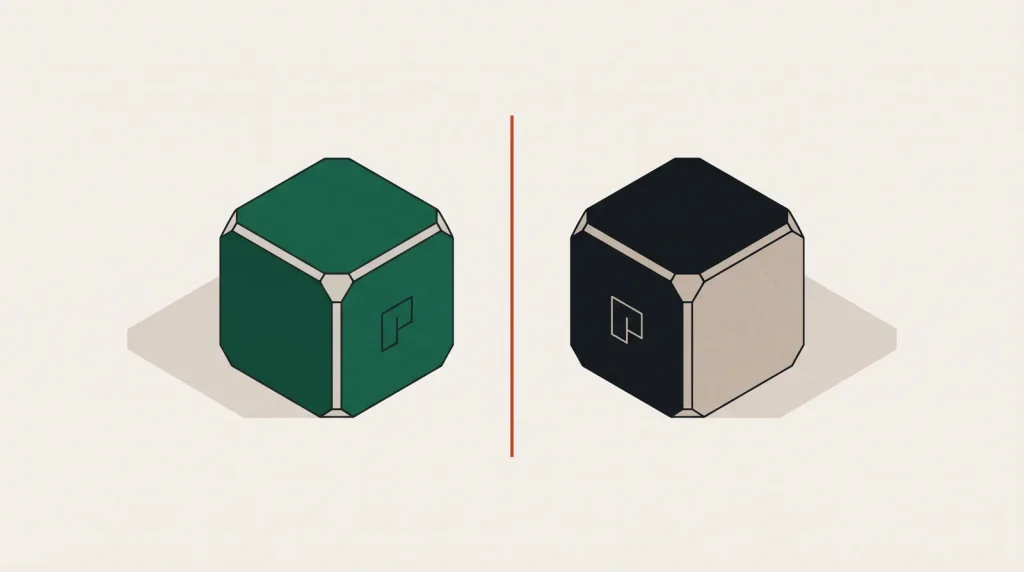
Two plans, the same core count, one costs twice as much. The difference is not how much CPU you get; it is how reliably you get it.
The three models
| Model | What you get | Typical use |
|---|---|---|
| Shared | Cores shared with other tenants, fair-share scheduled | Web servers, small apps, development |
| Burstable / credit | A low baseline plus credits for short bursts | Bursty low-average workloads |
| Dedicated | Physical cores reserved for you | Databases, CI, sustained compute |
Shared plans are not oversold in a dishonest sense. They rely on the accurate observation that most servers idle most of the time, so capacity can be pooled. The plan works until several tenants are busy simultaneously.
Burstable plans and the credit trap
Credit-based instances — AWS T-family, and similar plans elsewhere — give a baseline such as 20 per cent of a core, and accumulate credits while below it. Bursting above the baseline spends credits.
The trap is what happens when credits run out. The instance is throttled to the baseline, which can be a fraction of the performance you were seeing. Everything slows down at once, and the CPU graph looks fine because it is pinned exactly at the baseline.
Burstable plans suit workloads that are genuinely idle most of the time. They are a poor fit for anything with sustained load, and a very poor fit for a database.
Steal time: the number to watch
Steal time is the percentage of time your virtual CPU was ready to run but the hypervisor gave the physical core to someone else. Read it with top, vmstat or sar — the st column.
- 0 to 1 per cent — normal, nothing to do.
- 2 to 5 per cent — noticeable on latency-sensitive work.
- Above 10 per cent — you are losing significant capacity to neighbours.
Persistent high steal time is the concrete evidence that a dedicated plan would help. Without it, you are speculating about a noisy neighbour who may not exist.
What needs dedicated cores
- Databases under sustained load — latency variance shows up directly in query times.
- CI and build runners — sustained 100 per cent CPU is exactly what shared plans throttle.
- Video encoding and batch processing — long CPU-bound jobs.
- Realtime services — game servers, trading, anything where p99 latency matters more than the average.
- Benchmarking — shared cores make results meaningless.
And what does not: static sites, low-traffic web applications, development environments, staging, cron jobs, and most CMS installations. These spend most of their time waiting, and shared cores are exactly the right purchase.
How the providers name it
| Provider | Shared | Dedicated |
|---|---|---|
| Hetzner | CX / CPX shared vCPU | CCX dedicated vCPU |
| DigitalOcean | Basic Droplets | CPU-Optimized, General Purpose |
| Linode | Shared CPU | Dedicated CPU |
| UpCloud | General Purpose | High CPU |
| AWS | T-family burstable | C, M and R families |
| Google Cloud | E2 shared-core, N-series | C-series |
Names differ; the underlying distinction is the same everywhere. Read the plan description for the words “shared”, “burstable” or “baseline” — those signal the first two models.
A decision that takes five minutes
- Start on a shared plan. It is cheaper and usually sufficient.
- Watch steal time and response-time percentiles for two weeks.
- If steal time stays low and p99 latency is stable, stay where you are.
- If either degrades at predictable times of day, move that workload to dedicated.
- Keep databases and CI on dedicated from the start; the evidence is already in.
Common questions
Is a shared vCPU half a core?
No. It is a full core that may be shared with other tenants. Under low contention you get close to a full core; under high contention you get less.
Does dedicated mean better hardware?
Sometimes the generation is newer, but the core promise is exclusivity, not speed. Compare the actual processor if single-core performance matters to you.
Can I move between plan types?
On most providers yes, with a reboot. Some require a rebuild if the instance family changes. Check before you build something hard to move.
Why does my burstable instance suddenly get slow?
Almost always exhausted CPU credits. The provider dashboard shows the credit balance; when it reaches zero, performance drops to the baseline until credits rebuild.
Where to go next
See how to size a cloud server and Hetzner versus DigitalOcean, where this distinction drives most of the price gap.
Read next

How to Size a Cloud Server Without Guessing
Most servers are the wrong size in one direction or the other.
Uptime, Availability Zones and What Redundancy Really Costs
Every extra nine costs more than the last. Deciding how many you need is a business decision that engineering keeps…

Monitoring a Cloud Server: The Six Numbers That Matter
A dashboard with forty graphs tells you nothing at 3am. Six metrics and three alerts tell you almost everything.